Global Entry vs NEXUS: Which Trusted Traveler Program in 2026?
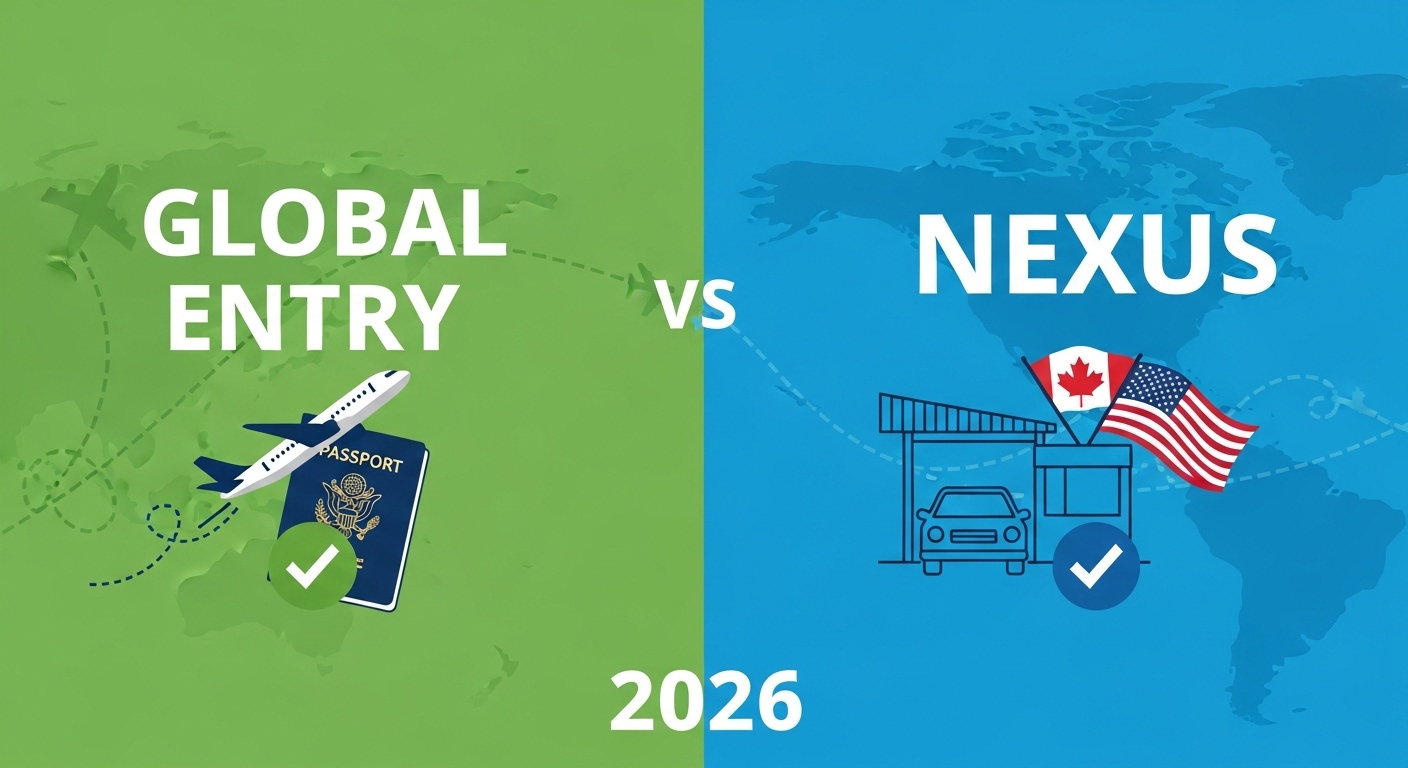
NEXUS costs half as much as Global Entry and includes Global Entry benefits when you enter the U.S. - but eligibility and interview locations are different. Here’s how the two programs compare in 2026: cost, who can apply, where you interview, and when to choose each.
In this article
What is NEXUS?
NEXUS is a U.S.–Canada trusted traveler program run by U.S. CBP and the Canada Border Services Agency (CBSA). Members get expedited processing when entering the United States and when entering Canada. When you use NEXUS to enter the U.S., you receive the same benefits as Global Entry: use of Global Entry kiosks (or the equivalent expedited lane), no paper customs form, and your NEXUS membership also qualifies you for TSA PreCheck when you add your Known Traveler Number (KTN) to your airline reservation.
Quick take
NEXUS costs $50 for 5 years. Global Entry costs $100 for 5 years. NEXUS includes Global Entry–style benefits when entering the U.S. and TSA PreCheck - so if you’re eligible for NEXUS and can get to a NEXUS enrollment center, NEXUS is the better deal. The catch: NEXUS enrollment centers are only at certain U.S.–Canada border locations and a few Canadian airports; there are far fewer than Global Entry–only centers.
Global Entry vs NEXUS at a glance
| Feature | Global Entry | NEXUS |
|---|---|---|
| Cost | $100 for 5 years | $50 for 5 years |
| Expedited U.S. customs (returning to USA) | ✓ | ✓ |
| TSA PreCheck (domestic & outbound) | ✓ | ✓ |
| Expedited entry into Canada | ✗ | ✓ |
| Eligibility | U.S. citizens, LPRs, and some other nationals | U.S. and Canadian citizens, LPRs of both countries; limited Mexican citizens |
| Interview locations | 200+ U.S. enrollment centers (airports, etc.) | NEXUS enrollment centers (U.S.–Canada border, some Canadian airports) |
| Application | Trusted Traveler Programs (TTP) site | Same TTP site - select NEXUS |
TL;DR
If you qualify for NEXUS and live near the border, it’s usually the better value. If you don’t, Global Entry is more accessible and easier to schedule.
Cost & renewal
NEXUS: $50 for 5 years. Global Entry: $100 for 5 years. Both are non-refundable. NEXUS is the cheapest way to get Global Entry–style benefits and TSA PreCheck if you qualify and can complete the NEXUS interview. If you already have or plan to get Global Entry, you don’t need NEXUS for U.S. entry - but NEXUS still gives you faster entry into Canada, which Global Entry does not.
Renewal: Global Entry renewal is $100 (same as first time) and can often be done online with no new interview - see how to renew Global Entry (2026). NEXUS renewal is $50 and may require another interview; both countries must re-approve you. Some credit cards reimburse Global Entry fees (e.g. $100 every 4–5 years); NEXUS reimbursement is less common, so check your card’s terms if fee offset matters to you.
Processing times & approval differences
Conditional approval time: For Global Entry, conditional approval often takes a few weeks to several months; in 2026 many applicants wait 2–6+ months before they can schedule an interview. NEXUS conditional approval also varies - you’re being reviewed by both CBP and CBSA, so it can be a bit longer or similar depending on the period. There’s no public formula for either; both use background checks and risk assessment.
Interview structure: Global Entry interviews are one-on-one with a CBP officer at a U.S. enrollment center (or via Enrollment on Arrival). NEXUS interviews are joint U.S.–Canada: you meet with both CBP and CBSA (sometimes in one session, sometimes in sequence). Both sides must approve you. That can make NEXUS feel more involved, but approval odds for eligible, low-risk applicants are generally high for both programs.
From application to approved: Total time to “fully approved” depends on conditional approval plus how fast you can get an interview. For Global Entry, interview availability is the main bottleneck at busy centers - see Global Entry wait times 2026. For NEXUS, the bottleneck is often the limited number of enrollment centers and appointment supply at the border. Neither program publishes official approval-rate statistics.
Pros and cons
NEXUS
- Pros: Half the cost ($50 vs $100); includes Global Entry–style U.S. entry and TSA PreCheck; expedited entry into Canada; use of NEXUS/SENTRI lanes at the U.S.–Mexico border in some cases (see FAQ).
- Cons: Only for U.S./Canadian citizens or PRs (and limited others); interviews only at border/Canada locations; joint U.S.–Canada approval required; fewer centers = harder to schedule; NEXUS card required for some land crossings; not all credit cards reimburse NEXUS.
Global Entry
- Pros: More enrollment centers (200+), including major U.S. airports; Enrollment on Arrival option; no need to travel to the border; broader eligibility (e.g. some non–U.S./Canadian nationals); many credit cards reimburse the fee.
- Cons: Higher cost ($100); no Canada expedited entry; no NEXUS/SENTRI land-border benefit.
Eligibility
Global Entry is available to U.S. citizens, U.S. lawful permanent residents, and certain citizens of other countries (e.g. Mexico, certain partner countries). Check the official Trusted Traveler Programs site for the full list.
NEXUS is available to U.S. citizens, U.S. lawful permanent residents, Canadian citizens, and Canadian permanent residents. A limited number of Mexican citizens may also be eligible under specific criteria. You apply for NEXUS through the same TTP portal - you choose NEXUS instead of Global Entry when starting your application.
If you’re a Canadian citizen or PR, NEXUS is often the obvious choice: you get faster entry into both the U.S. and Canada. If you’re a U.S. citizen or LPR who travels to Canada often or lives near the border, NEXUS can be worth it for the lower fee and Canadian benefits.
Where you interview
Global Entry interviews take place at 200+ U.S. enrollment centers - including many major airports. You can also complete your interview via Enrollment on Arrival when returning from an international trip at participating airports. In 2026, appointment availability at popular centers is often scarce; see Global Entry wait times 2026 for which locations tend to have openings, and why appointments disappear in 60 seconds if you’re trying to grab a slot.
NEXUS interviews are only at designated NEXUS enrollment centers. These are located at U.S.–Canada land borders and at a few Canadian airports. There are no NEXUS-only centers in the middle of the U.S. So if you don’t live near Canada or can’t easily travel to a NEXUS center, getting a NEXUS interview can be impractical - in that case, Global Entry is the only option for Global Entry–style U.S. benefits.
NEXUS enrollment centers can have long wait times or limited appointment supply too. If you’re applying for Global Entry and need an interview at a U.S. center, an alert service can notify you when a slot opens; that doesn’t apply to NEXUS centers in the same way, but the comparison is still useful when deciding which program to apply for.
Practical considerations most people miss
- NEXUS requires joint U.S.–Canada approval. Both CBP and CBSA must approve your application and interview. If one side delays or requests more info, your timeline can stretch.
- Fewer NEXUS enrollment centers = longer scheduling constraints. You can’t “pop in” at a random U.S. airport; you have to get to a border or Canadian NEXUS location. That often means planning a dedicated trip.
- NEXUS card is required for certain land crossings. When entering the U.S. or Canada by land, you typically need to show your NEXUS card (and follow NEXUS lane rules). For air entry to the U.S., your passport and KTN are usually enough; the card still helps to have on hand.
- Credit card reimbursement: Many U.S. premium cards reimburse Global Entry (or TSA PreCheck) every few years. NEXUS reimbursement is less common - always check your card’s benefit terms. If you’re counting on a $100 credit, Global Entry may be the safer bet.
- Children and families: Both programs allow children; each person (including kids) needs their own membership and interview. For NEXUS, the whole family must be able to get to a NEXUS center. For Global Entry, you can use Enrollment on Arrival with kids when returning from abroad, which can simplify scheduling. See can a child apply for Global Entry for family logistics.
Which should you choose?
Choose NEXUS if:
- You’re a U.S. or Canadian citizen or permanent resident (or otherwise eligible for NEXUS).
- You can reasonably travel to a NEXUS enrollment center (near the U.S.–Canada border or a participating Canadian airport).
- You want the lowest-cost way to get Global Entry–style U.S. entry plus TSA PreCheck.
- You travel to Canada or cross the U.S.–Canada border often - NEXUS gives you expedited entry into Canada; Global Entry does not.
Choose Global Entry if:
- You’re not eligible for NEXUS (e.g. you’re not a U.S. or Canadian citizen/PR).
- You can’t or don’t want to go to a NEXUS enrollment center (e.g. you live far from the border).
- You only need fast re-entry into the U.S. and TSA PreCheck, and you prefer to interview at a U.S. airport or use Enrollment on Arrival.
- You want to complete your interview when returning from abroad via EoA - that option exists for Global Entry, not for NEXUS.
Going with Global Entry? Get notified when an interview opens.
GE Finder monitors 200+ U.S. enrollment centers 24/7 and emails you the moment a slot opens at your chosen locations - so you can book on the official TTP site and stop refreshing.
Get instant alertsSummary
If you qualify for both and can get to a NEXUS center, NEXUS is usually the better value: half the price and you get U.S. Global Entry–style benefits plus faster entry into Canada. If you don’t live near the border or aren’t eligible for NEXUS, Global Entry is the way to get expedited U.S. customs and TSA PreCheck. For a domestic-only comparison, see Global Entry vs TSA PreCheck.
Frequently asked questions
Does NEXUS include Global Entry?
When you use NEXUS to enter the United States, you get the same expedited processing as Global Entry (kiosks, no paper form, etc.). Your NEXUS membership also makes you eligible for TSA PreCheck when you add your KTN to your flight reservation. So in practice, NEXUS gives you “Global Entry” benefits for U.S. entry plus TSA PreCheck, plus expedited entry into Canada.
Is NEXUS harder to get approved for?
NEXUS requires approval from both U.S. CBP and Canada CBSA, so in that sense there are “two gates” - but the eligibility and background-check standards are similar in spirit to Global Entry. If you’re a low-risk, eligible applicant with no red flags, approval odds are generally high for both. Neither program publishes approval rates. The main “harder” part of NEXUS is logistical: you must get to a NEXUS enrollment center, which can be harder than booking a Global Entry interview at an airport near you.
Can you switch from Global Entry to NEXUS?
There’s no formal “switch.” You can apply for NEXUS while you have Global Entry (or after it expires). If approved for NEXUS, you’ll have both benefits: use NEXUS when entering Canada or at NEXUS/SENTRI lanes, and you still have Global Entry–style U.S. entry via your NEXUS membership. Many people simply let Global Entry lapse and only renew NEXUS if they qualify and use the Canada benefit.
Does NEXUS work in Canadian airports with U.S. preclearance?
Yes. At Canadian airports that have U.S. preclearance (e.g. Vancouver, Toronto Pearson, Montreal), you can use NEXUS to expedite your way through the U.S. customs and immigration process before you board your flight to the States. You’re still entering the U.S.; the inspection just happens on the Canadian side. NEXUS members use the designated NEXUS/Trusted Traveler lane where available.
Can I use NEXUS for SENTRI lanes at the U.S.–Mexico border?
NEXUS members are eligible to use the SENTRI lanes when entering the U.S. from Mexico by vehicle. SENTRI is the U.S.–Mexico trusted traveler program; CBP allows NEXUS (and Global Entry) members to use SENTRI lanes at land border crossings. So if you have NEXUS, you get expedited vehicle entry from both Canada (NEXUS lanes) and Mexico (SENTRI lanes) - a useful detail if you cross either border by car.
Can I have both Global Entry and NEXUS?
You can, but it’s not necessary. If you have NEXUS, you already get Global Entry–style benefits when entering the U.S. Most people choose one or the other based on eligibility and where they can interview.
How long does NEXUS approval take?
Processing times vary. You apply online, pay the fee, and wait for conditional approval. Once conditionally approved, you must schedule and complete an interview at a NEXUS enrollment center. Total time can be several weeks to several months depending on CBP/CBSA and appointment availability.
Where are NEXUS enrollment centers?
NEXUS enrollment centers are at certain U.S.–Canada border locations and at a few Canadian airports. There is no NEXUS enrollment in the interior U.S. Check the official Trusted Traveler Programs site for the current list.
If I have NEXUS, do I get a Global Entry card?
You receive a NEXUS card, not a Global Entry card. When entering the U.S. by air, you use the Global Entry kiosks and present your passport (and your NEXUS card if requested). Your NEXUS membership is linked to your passport and KTN for TSA PreCheck. For land crossings into the U.S. or Canada, you typically need to show your physical NEXUS card and use the NEXUS lane.
Applying for Global Entry? Get notified when an interview opens.
GE Finder monitors 200+ U.S. enrollment centers 24/7 and emails you the moment an interview slot opens at your chosen locations - so you can book on the official TTP site and stop refreshing.
Get instant alerts